


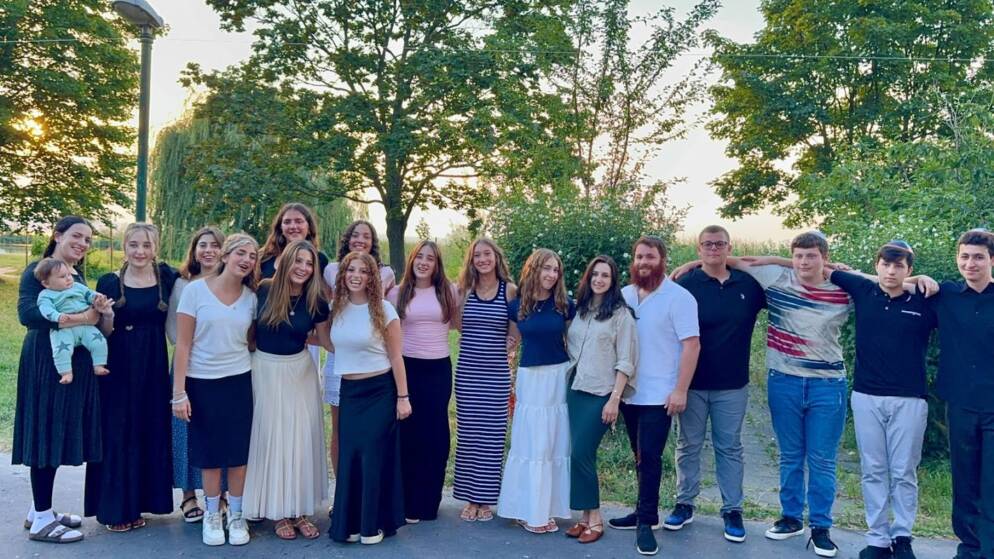
For a group of teens from Bucks County who attended a gathering of young Jews from across the world in Hungary this summer, the trip was one rewarding experience after another.
However, the trip’s chaperone, Rabbi Chaim Shemtov, said there was one activity that hit harder than the rest.
“We went to a town that had its Jewish population decimated down to five or 10 individuals,” he said. “We went to the dilapidated Jewish cemetery — overgrown with weeds — that was once thriving and is now uncared for, and we went and repaired some of the headstones and graves. Rarely is there an action where the past generation is relying on the current generation to bring things forward, and it’s a phenomenal message for the teens to walk away from.”
Shemtov is the co-director of the Bucks County chapter of CTeen, the Chabad subgroup that organized the trip. Along with the other co-director — his wife, Nina — Shemtov directed more than a dozen Jewish teens around Lake Balaton, Hungary, from July 15-25. Students visited Jewish sites and got to know other young Jews from around Europe and Israel.
One attendee, 14-year-old Mikaela Senders, said she was definitely worried about what could go wrong, but that she knew she had to go.
“CTeen wants to expand my horizons with Judaism, and I was a little scared at first with all the antisemetism going on, but I knew in the long run that this was going to be good for me to go,” she said.

Shemtov said most of the programming was centered around creating ties between Jews across international lines in the hope that it fosters camaraderie for those who need it most.
“We had [teens] who were refugees from Ukraine. There were some [teens] who were from displaced families in Israel because of the current conflict there,” he said.
Sixteen-year-old Izzy Dobrin said her eyes were opened to how different life can be for other Jews, even with the common bond of religion.
“There were these girls from Israel who had to move to Cyprus who we became really close with. They would always talk about missing their homes in Israel. We want to visit them when they get back to Israel, because they became like my sisters,” she said.
Dobrin said that stories of Israeli students having to run for bomb shelters or practice various precautions as a part of their everyday lives really impacted how she sees her own reality in the United States.
“We just don’t have that in America, and it’s so normalized there,” she said.
Shemtov said watching the connections made on the trip transition from awkward introductions to lifelong, sibling-esque bonds is something he will take with him.
Sender added that this doesn’t just go for international connections.
“I was close with some of the girls in my chapter [before the trip] but since we have been back I have become best friends with a lot of them,” she said.
The trip spurred action from some of the attendees. Some of the Bucks County CTeen members have decided to start Jewish clubs at their schools, designed to share Jewish culture with non-Jews and unite everyone against antisemitism.
Shemtov said there were also instances of individual growth, too. A 16-year-old student, Elizabeth Kraychik, received her Hebrew name in Hungary. In a news release about the trip, Kraychik described the emotions she felt.
“I’ve always wanted a Jewish name and CTeen Balaton was the best place to get one. I felt such an immense connection with God as my new name was read aloud next to the Torah scroll, surrounded by all my amazing friends,” she said. “I’m so grateful for this experience.”
The teens’ growth in their Jewish identity didn’t end in Hungary, Shemtov said.
“On a spiritual level, the structure of prayer, study and Shabbat and all those exciting things led to tremendous growth with our teens,” he said. “They made resolutions for the upcoming year: volunteering, community service, tefillin and [lighting] Shabbat candles,” he said.
It wasn’t all serious, though. Sender said there are some memories from the trip that she will treasure not because they strengthened her connection to Judaism, but because they made her laugh.
“One of our friends’ bunks broke and they had to sleep on that and it was so funny how it just kept breaking more every single day,” she said. “And then once I was just getting ready for a nap and [other attendees] came into our bunk and started spraying us with water guns — it was really funny!”
Shemtov said that, for him, the constant mix-ups thanks to the language barriers were good entertainment.
“Finding fun in each other’s cultures was really humorous,” he said.
aguckes@midatlanticmedia.com